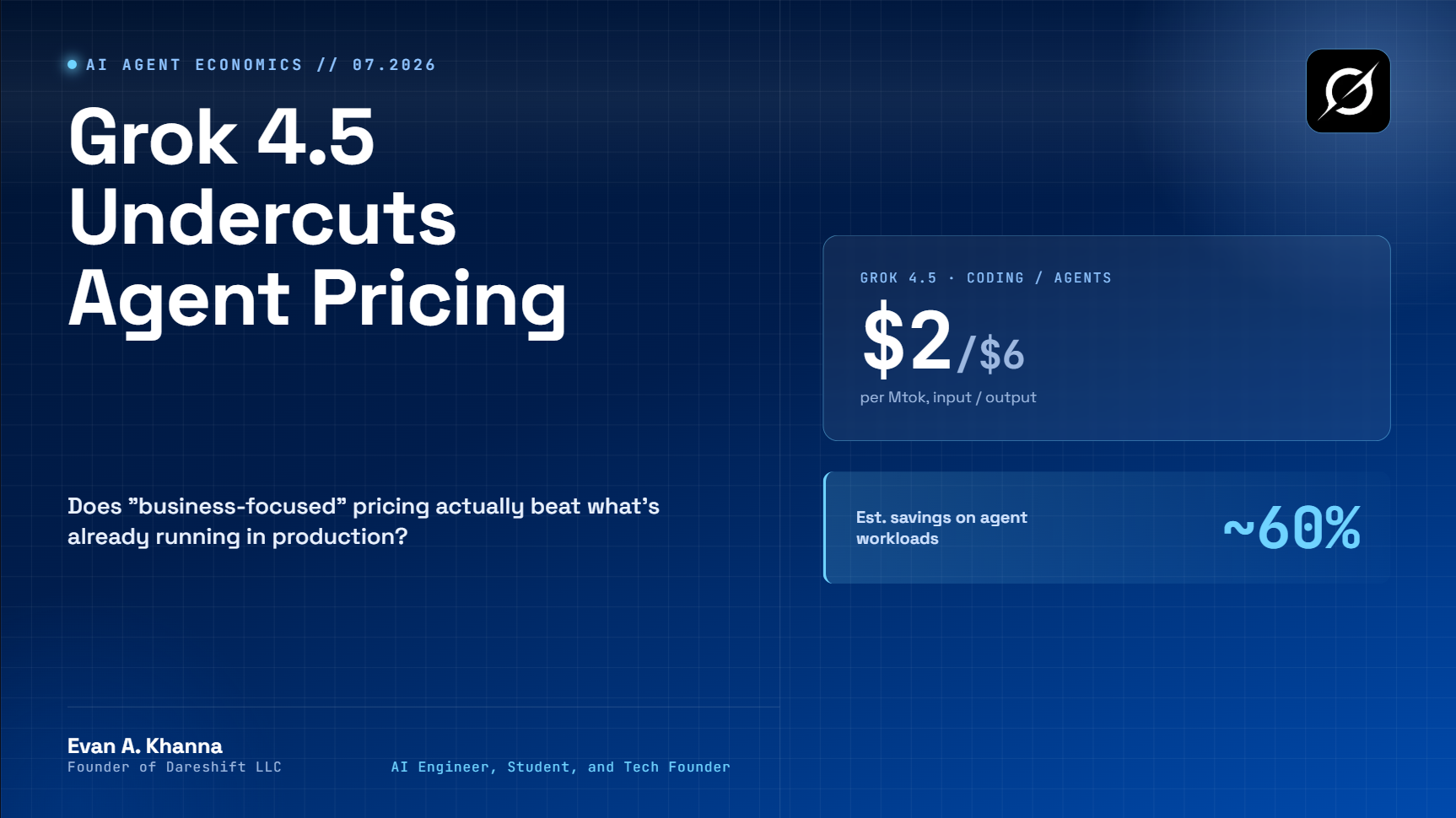
The recent Grok 4.5 pricing announcement for coding and agent workloads, $2 input / $6 output per million tokens, represents a significant move in the competitive LLM market. However, a deeper analysis of agent economics reveals that sticker price represents only one component of total cost of ownership in production systems.
Stated vs. Effective Pricing
Grok 4.5's pricing structure offers a substantial reduction relative to Anthropic's Opus-class models and comparable tier-1 offerings in the enterprise LLM market. For inference-heavy agentic workloads, particularly those involving iterative model calls and tool invocations, this pricing differential is material.
The critical question is whether this cost advantage translates directly to operational efficiency or whether hidden factors offset the per-token savings.
Early Third-Party Assessment
Initial reports from early adopters suggest Grok 4.5 may achieve lower tokens-per-task completion on coding and structured output workloads compared to some incumbent models, which would materially improve effective cost efficiency beyond the headline per-token rates. This represents a potential quality-and-cost advantage worth validating through controlled testing.
Operational Cost Factors in Agent Systems
Token Efficiency and Output Length
The pricing advantage assumes parity in output quality and completion length. As a scenario assumption, if Grok achieves comparable reasoning performance at the cost of 20–30% longer completions (a plausible but unvalidated scenario), the effective per-task savings would diminish proportionally. Empirical testing on structured agent tasks will be required to validate true cost efficiency.
Failure Rate and Retry Overhead
Agent workloads compound system dependencies. Each model invocation introduces the potential for structured output failures, tool-calling inconsistencies, or reasoning errors that trigger retry loops. As a scenario assumption, if failure rates increase by 5-10% across agent pipelines (a risk scenario rather than observed baseline), the effective cost advantage would be substantially offset through additional compute cycles and operational overhead.
Latency and Throughput Costs
In production environments, inference latency directly impacts system capacity and operational costs. Slower model performance extends task completion times, increasing resource utilization and potentially reducing throughput on constrained infrastructure. This latency cost is often underestimated in pricing comparisons.
Reliability and Production Complexity
Agent systems exhibit error amplification across multi-step workflows. A single hallucination or output inconsistency in a 10-step agentic process can trigger cascading failures, requiring additional validation layers, error correction logic, or manual intervention. The resulting operational burden, validation overhead, monitoring complexity, incident response, constitutes a substantial but often-hidden cost.
Strategic Implications
For Established Production Systems
Organizations with mature agentic systems already deployed on incumbent platforms face meaningful switching costs: prompt reoptimization, comprehensive testing across failure scenarios, and risk associated with unknown edge cases in production. As a scenario assumption, unless cost savings exceed 40–50% on actual workloads (a threshold that varies by organization), migration economics typically favor continuity over disruption.
For New Development
Teams building agent systems from initial conception can rationalize training on cost-effective infrastructure during the development and validation phase. Lower per-iteration costs enable more extensive experimentation and empirical testing before production deployment decisions.
Critical Validation Metrics
The assessment of Grok 4.5 as a competitive agent platform requires validation across several dimensions:
- Structured output reliability: Consistency of function calling and schema compliance under diverse agent task scenarios
- Long-horizon reasoning: Performance on multi-step reasoning tasks with accumulated context
- Tool integration quality: Accuracy and consistency in tool selection and parameter generation
- Production deployment data: Real-world performance metrics from early adopters at scale
Conclusion
While Grok 4.5's pricing represents meaningful competitive pressure in the LLM market, the total cost of ownership for agent workloads extends beyond per-token rates. Early indications suggest potential advantages on coding efficiency, but these require production validation. Organizations should conduct empirical cost-benefit analysis specific to their use cases before making provider migration decisions. Cost savings on headline pricing must be evaluated against operational reliability, system complexity, and migration risk.
0 Comments